
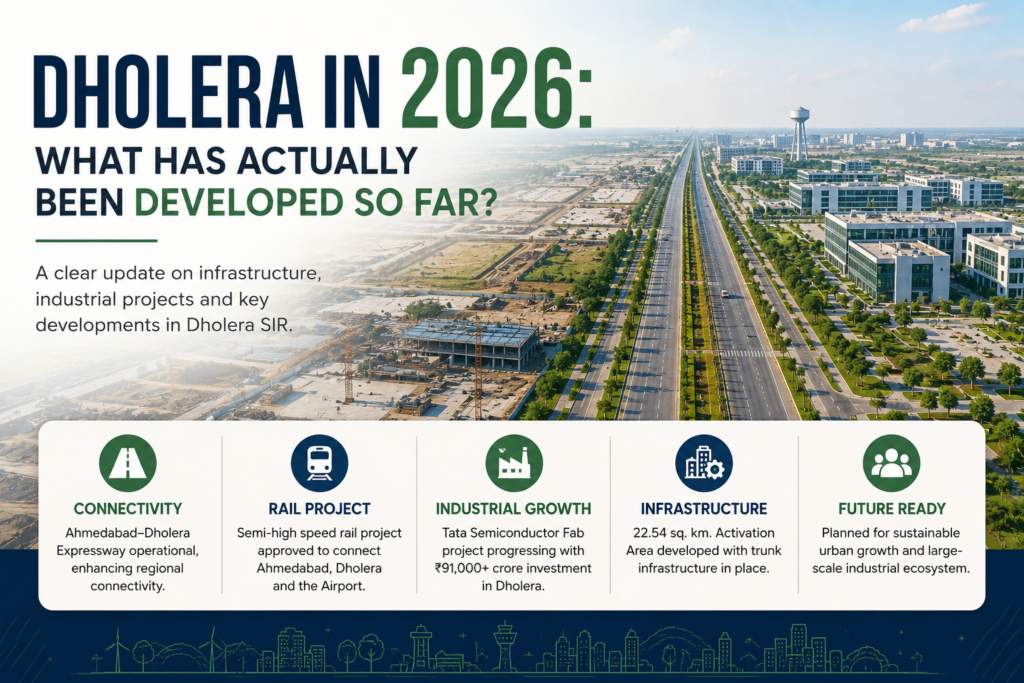
Dholera’s development story has attracted significant attention from property investors and businesses, but serious investment decisions require a clear distinction between what has been completed, what is under development and what remains part of the longer-term plan.
As of 2026, Dholera is no longer simply a proposed industrial city on paper. Several important infrastructure and industrial milestones have moved forward. At the same time, the entire 920 sq. km. planned region should not be described as fully developed.
The 920 Sq. Km. Region and Activation Area
The Dholera Special Investment Region covers approximately 920 sq. km. However, development is being phased.
The first major implementation zone is the 22.54 sq. km. Activation Area. NICDC currently describes this area as almost completed, with trunk infrastructure already established.
This is one of the most important facts for prospective land buyers to understand. The overall Dholera SIR boundary is much larger than the area where core development has already taken place.
Therefore, investors should always evaluate the exact location and development status of a property, rather than relying only on the broader “Dholera” name.
Road Connectivity Has Advanced
One of the most significant infrastructure developments is the Ahmedabad–Dholera Expressway.
The 109.019-km greenfield expressway was developed at a reported project cost of approximately ₹5,800 crore and provides direct connectivity between Ahmedabad and Dholera SIR. Government communications in 2026 describe the expressway as an important regional connectivity asset supporting the Dholera industrial region.
Improved road connectivity is strategically important for an industrial destination because movement of people, raw materials, finished products and services depends heavily on reliable transportation.
Rail Connectivity Is Moving Forward
Another important 2026 development is the approval of the Ahmedabad (Sarkhej)–Dholera semi-high-speed double-line railway project.
The Cabinet approved the approximately ₹20,667-crore project in May 2026. The proposed 134-km railway connection is intended to link Ahmedabad with Dholera SIR, the upcoming Dholera Airport and Lothal.
For investors, this should be understood as a future connectivity project, not as an already operational railway service.
That distinction is important when evaluating real-estate claims.
Semiconductor Manufacturing Has Become a Major Anchor
Perhaps the most significant industrial development associated with Dholera is the Tata semiconductor fabrication project.
The project has an announced investment exceeding ₹91,000 crore and planned capacity of 50,000 wafer starts per month. Government sources identify it as India’s first commercial semiconductor fabrication facility.
In April 2026, the Government notified the semiconductor-related SEZ at Dholera. The notified SEZ covers 66.166 hectares and is projected to support approximately 21,000 employment opportunities.
The technology ecosystem also gained momentum in May 2026 when Tata Electronics and ASML signed an agreement supporting the Dholera semiconductor fab.
Other Infrastructure and Industrial Development
Dholera’s development is not limited to one semiconductor facility. Official project material identifies focus sectors including aerospace and defence, solar components, green hydrogen, pharmaceuticals and biotechnology, and heavy engineering.
The region has also been developed around integrated utility and trunk-infrastructure systems intended to support industrial operations.
However, investors should avoid presenting every proposed project or planned facility as an operational asset.
What Does the 2026 Position Tell Investors?
The clearest conclusion is that Dholera has moved from conceptual planning towards physical infrastructure and industrial execution, but it remains a long-term, phased development.
For a land buyer, the correct approach is therefore to separate three categories:
Completed: infrastructure and facilities that are already operational or substantially developed.
Under development: projects where construction or implementation is progressing.
Planned: projects that have been announced, approved or proposed but are not yet operational.
This distinction creates a more realistic understanding of Dholera.
For long-term investors and businesses, the significance of 2026 is not that Dholera is “finished.” It is that the region now has tangible infrastructure, major industrial commitments and a growing technology ecosystem against which its future development can be evaluated.
